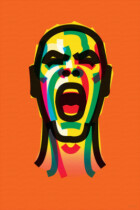


Scream II is a large-format mixed media painting on canvas, where inks, acrylics, and other materials combine to create a rich visual language. The work is visually and conceptually oriented towards the experiences of the human psyche — catharsis, freedom, frustration, and inner conflicts. The artist seeks to reflect the contradictory feelings inherent in contemporary reality, rather than just a decorative painting.
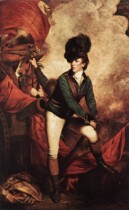
Portrait of Colonel Tarleton is a fine example of academic painting. Academism favored narrative or historical painting by putting forward model painting. This is what the artists called the "great style" of which Reynolds was one of the proponents. His painting illustrates the colonel in the event that could ideally have unfolded. Reynolds tends to the universal and the emblematic by emphasizing the composition and the form. That is why the colonel's clothes are relatively simple and the action in the background is used for simple decoration. However, the posture and the look of the main character reflect his military triumph as well as his nobility and bravery.
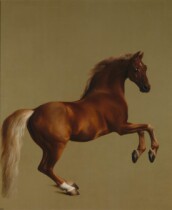
Whistlejacket by Stubbs is a great example of academic painting. According to academism, art could be taught by rules. It promoted the classical ideals of beauty and artistic perfection. Founded in Europe during the seventeenth century, academies dominated the arts until the late nineteenth century. Many of the most distinguished artists were striving to become members of the academy. They participated in the search of fundamental principles and ideals across the genres of academic painting. This is a precise hierarchy within the fine arts that emphasized mythological, religious and patriotic themes as well as strong knowledge of anatomy. Stubbs pursues academic values by paying close attention to this anatomical drawing of the horse. He also makes a series of engravings The Anatomy of the Horse which impresses with its realism and scientific accuracy.

This painting by Watteau is a great example of Rococo, a style that prevailed in France during the reign of Louis XV. An art highly ornamented, Rococo means "Rocaille". Originally it was an insult invented by a pupil of David who was referring to the walls of caves decorated with shells and small stones. Looking at The Embarkation for Cythera, we can notice that Watteau takes the sinuous forms of baroque art, but with more grace and lightness. It is an allegorical scene full of sensitivity. We see his characters coming to the island that evokes a world of pleasure and beauty, where everyone must meet their ideal partner. The lovers have formed couples and are about to return home. As most of the couples prepare to leave, two lovers linger near the decorated statue of Venus as if spellbound in love. One of the women walking away turns around and gazes at them sadly knowing that this time of love is the most fleeting. Playfulness of the atmosphere makes a melancholic allusion to youth and love. The colors of autumn and the lightness of brush imply the loss and the underlying fragility of this ethereal atmosphere. We will invent the term "Fête galante" (courtship party) for this masterpiece which gives preference to a slight elegance and flirt at the expense of a more vigorous emotional expression.

During the Baroque period, the governors openly expressed their faith in the absolute power that originated from the ancient doctrine of the "divine right" of kings. The allegorical and mythological paintings predominated in the field of the arts. Commissioned by Marie de Medici, paintings of Rubens were keeping up with the times. In one of these paintings, Louis XIII and his mother, Marie de Medici, are sailing on the boat that symbolizes France. At the stern of the ship, the young king wears a crown and holds the rudder, showing that he governs the State without difficulty. Marie de Medici points out the right way to steer the ship as if she were transmitting power to the king. This gesture may signify the end of the queen mother's regency. The powerful rowers represent the virtues attributed to the king: Force (the lion), Religion (illuminated altar), Justice (balance) and Concorde (caduceus). Holding the globe and the sword, the woman perched in front of the mast of the ship symbolizes the sovereignty and authority of France. All these virtues remind us that the king is virtuous and victorious. This work of propaganda provided a perfect support for absolutist ideals and served to create a glorious image of the monarchy.
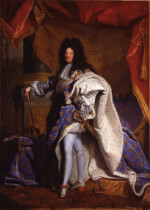
Commissioned by the royal court, this artwork by Rigaud served to increase the power of Louis XIV and to shape an official art centered on the person and the preferences of the monarch. The portrait of Louis XIV summarizes the famous formula of the king - "The State is me". It is an image of absolute monarchy in which power is concentrated in the hands of the sovereign. The king looks at us with that nobility that expresses authority and self-confidence. His sword emphasizes military success and his posture expresses energy and vigor. In the middle of the luxurious decor, Louis XIV wears the sumptuous and glorious outfit that reminds us of the supremacy of France in Europe in the first half of the 18th century.
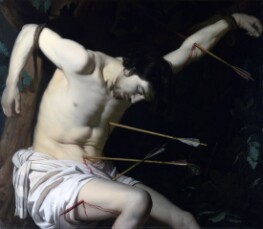
Influenced by Caravaggio and his use of chiaroscuro, Van Honthorst produced his works in a striking and vigorous manner. His nocturnal scenes often show characters lit by the bright light of a candle. In the same way, Van Honthorst represents Saint Sebastian using a technique of chiaroscuro, which strikes the imagination of the viewer. The close-up pose increases the dramatic power and gives the impression to the spectator to be able to touch the saint by stretching out his arm. Instead of idealizing his character, Van Honthorst represents Saint Sebastian as the ordinary person. His body seems to be simultaneously sexual and spiritual, which brings to a work an erotic tension.

Velasquez's Christ on the Cross is an example of Baroque art that evokes intense emotions of the viewer. One of the techniques that Velasquez uses is the diminution of the real and psychological distance between the work of art and the viewer. Velasquez has reduced the foreground so that the viewer gets very close to Christ. The representation of any decor or characters traditionally associated with the Crucifixion is useless here. The absence of background and the revelation of a central character amplify the emotional reaction of the viewer. Another typical technique utilized by Velázquez is chiaroscuro. By using this contrast between shadow and light, he reinforces the dramatic impact of the painting. The painter forces the viewer to observe impressively realistic body and the face of Christ illuminated by the external light. Being very close to this brutal scene, the viewer seems alone in witnessing the suffering and the death of Christ.
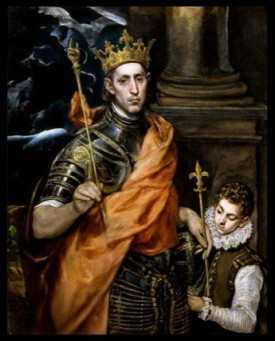
This painting by El Greco is exemplary in terms of meaningful facial expressions and body postures. Saint Louis holds the Hand of Justice, which symbolizes the king's power to judge. In other words, it is the king's hand that strikes, caresses and blesses. Traditionally, this scepter was attributed to a religious meaning which symbolized the Trinity. It affirmed the holiness of the king, transmitted from monarch to monarch. In the other hand, Saint Louis holds the fleur-de-lis which implies the source of power. All these gestures highlight the status and the role of Louis IX who was considered the reformer king with his reputation beyond the borders of the Kingdom.

This picture of Zurbaran depicts dead Saint Bonaventure. In the background we can see the monks kneeling and the pope pointing with his hand at Bonaventure's body. This work, symbolizing the counter-reformation in Spain, is dedicated to Catholic worship of saints and relics, in contrast to the Protestant denial of idolatry. In Catholic art, an image of painting is considered to be an integral part of truth because it is seen as an object of devotion. This is why Zurbaran, like other artists of the Counter-Reformation, pays special attention to holiness as a life of obedience in the church.

The gesture is one of the essential aspects of baroque art. It reveals the soul through the movements of the body. In this picture of Guercino, overloaded with characters, various gestures reflect different emotions and reactions. The Christ who designates Lazarus means a miracle. Detaching the ties impeding the wrists of Lazarus symbolizes his liberation out of his grave. He is going out alive from a sepulcher under influence of Jesus. The woman who raises her hand or the man covering his mouth expresses the shock as an emotional response of the crowd. A man pointing at Lazarus to his interlocutor symbolizes the lesson. All these gestures aim to increase the emotional involvement of the viewer into the message of the painting.

This Rembrandt painting is a symbol of the Protestant Reformation, which forbade "idolatrous" religious images. Protestants considered Catholic worshiping of saints as superstition. They promoted the authority of the Bible and the possibility for a person to have direct contact with God without the participation of priests. It is not surprising that in this picture St. Matthew, who writes the Gospel, is depicted in a state of personal awareness, without any hint of worship. The woman behind him is an angel sent by God to dictate the words of truth. The profound expression on Matthew's face seems to tell us that God is setting him on the right path.
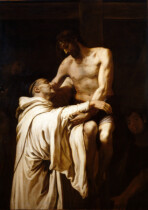
Bernard of Clairvaux was a French abbot who participated in the reformation of Catholic religious life in the 12th century. He sought the love of Christ by imposing a suffering, generally physical, to turn to God. After his death in 1153, Bernard was canonized and became Saint Bernard of Clairvaux. Francesco Ribalta, the Spanish Baroque painter, represents Saint Bernard with closed eyes, emphasizing his spiritual contemplation of Christ rather than a real physical encounter. Ribalta encourages us to meditate on the love of Christ for the church. His work aims to encourage a form of religious devotion that is rich in emotion and meditation. The expression of piety was often a means of opposing to Protestantism, which forbade art to play a central role in religious practice.
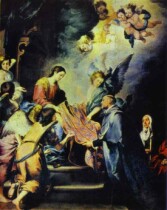
Ildefonso was a scholar and theologian who served as the Bishop of Toledo in Spain from 657 until his death on January 23, 667. He is known for his many treatises on dignity of Virgin Mary. The appearance of the Virgin Mary to Ildefonso has inspired many artists, including Murillo. In this painting by a Spanish artist, we see how Virgin Mary presents Ildefonso with a priestly vestment, symbolizing her virginity. Rewarded for his zeal in honoring Virgin Mary, Ildefonso accepts this gift, which emphasizes his status and role in the church. Murillo sends us an important message to glorify piety, an ardent attachment to serving God.

Nicolas Poussin, the founder of French classicism, paid much attention to form and design of the painting. He sought the harmony, balance and morality through classical composition. In Apollo in love with Daphne, Poussin creates a contrasting atmosphere. On one side, we feel a movement of the looks and intentions of the characters. Disappointed in his love for Daphne, he sees her embracing his father. On the background of the picture, dead Hyacinthe, unhappy in his friendship with Appolon, lies under the trees. The nymphs look at Appolon and Mercury is stealing his arrows. Appolon is however peaceful in the midst of this atmosphere where change and serenity come together. This situation seems a permanent condition of the world and belongs to the eternal order of endless changes.
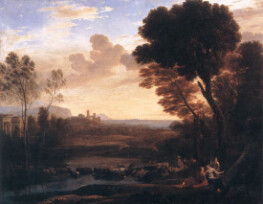
This painting by Lorrain is an example of the Baroque classicism, a style that combines rich imagination and the principles of classical composition. Lorrain, like other artists of the Baroque period, was interested in intellectual art, suitable for private contemplation. In this idealized landscape, the mythological characters of Paris and Oenone are almost lost in nature. Their story is secondary. More importantly, it is the atmosphere that this allegorical landscape of the golden age evokes. Classical buildings in the background, the contrast of light and shadows, the depth of space immerses the viewer in a kind of nostalgic state. We enjoy the landscape of a lost world from which only traces remained in this visual narrative.

This painting commissioned by Marie de Medici is an example of an allegorical painting whose elements accurately represents a general idea. Allegory is based on acquired knowledge. That is why it requires from the viewer a good knowledge of mythology, theology, classical history and literature. Allegory is very present in baroque art. Many artists used this form to influence our perception of church and state. An iconic allegorical figure may be the representation of a king or queen uniting the symbols of power. For example, artists of that period often compare contemporary monarchs to ancient rulers to attest that the king is victorious as was Caesar. In the same way, Gentileschi presents in his painting the queen who triumphs over the dangers hovering over the royal power during her regency. She's waiting for the storm to stop. The meaning is clear: Marie defends the rights of his son Louis XIII to have absolute power when he ascends the throne of France.

The Spring of Poussin is an allegory of divine creation. The painting shows an idealistic landscape in the morning which resembles the Garden of Eden. A naked woman pointing at an apple tree is most likely Eve and a naked man would be her partner, Adam. At the top, if you look closely, the Lord God himself hovers in the clouds occupied by his earthly creation. Based on the allegory, this picture seeks to associate the church with the greatness and authority of the ancient past. Therefore, Poussin relies more on Christianity than on pagan beliefs to tell his metaphorical story.

I like numerous glances of different characters in this painting. Everybody is interacting with each other. If we pay attention to the eyes of two drunks in the middle of the painting, we may notice that they are looking at the viewer. I seem directly involved in this scene of celebration full of relaxation, warmth and good feeling. As a participant, I see Bacchus, a god of wine, seated and naked to the waist in the center. He is rewarding a poor with grape leaves. I can observe god's face as he is looking away, but his thoughts and emotions are hard to read. This act of God can be considered as an allegory of releasing men temporarily from their problems while they are drinking a wine.
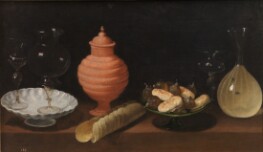
What I love about this painting is a subtle transition from the dark background to the outlines of the glasses. They seem like dissolving in the darkness leaving thin traces in the air. I also love the color of the pottery covered with small dots as if it was made of sugar. It blends harmoniously with the sweets that seem delicious and luxurious. Even though this painting is dated from 17th century, the sweets look like the products of the contemporary bakery shop. So, I would gladly taste them myself without hesitation.
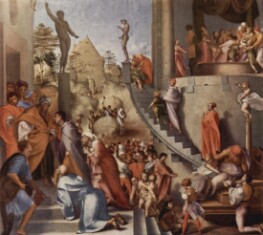
I like colors of this artistic composition. They make the painting memorable and unique. I also see a certain contrast between the theme and the way the artist depicted it. Pontormo combined with each other multiple legendary scenes from the life of Joseph. This juxtaposition of historic scenes along with soaring sculptures produces an effect of something monumental and grandiose. At the same time, joyful colors, unrealistic proportions and ignorance of perspective reduce a dramatic impression of the painting.
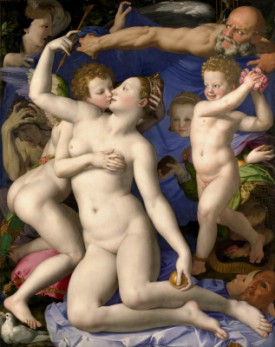
This Mannerist painting is overloaded with characters in unusual poses. Their emotions are varied and disturbed leaving more room for ambiguity and confusion than for clarity of interpretation. It is difficult to give meaning to this creative approach and to decipher a story. We can interpret it as the allegory of pleasure or love with its troubles and worries: Time (an old man), Oblivion (a man with the face of the mask), Folly (a little boy), Jealousy or Illness (a woman in agony) and Perversion (a girl with lion's paws and snake's tail).

It is a fairly realistic painting characterized by the variety of tones, effects of light and material. Everything is precise and coherent. The subtlety of details in the clothes, in the dog's fur, in the chandelier or in the mirror creates a special atmosphere of the scene. This representation of the world evokes feelings but without exaggeration and stylistic distortion. The painter seems very discreet in his approach to show emotions of the characters. The man and his wife are pale and calm. However, there is some softness in their traits and gestures that are in harmony with warm decorating colors of the room.
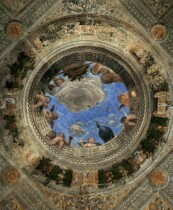
When we look at the ceiling in the Camera degli Sposi, we feel like we're at the bottom of a deep well. The top illusionistically opens to the blue sky by an oculus rounded with a balustrade. From this balustrade, angel-like boys, men, women and a peacock look down producing an effect of intrusion in a private room. To decorate a trompe-l'oeil ceiling, Mantegna uses the illusionistic technique of the foreshortening, especially in putti (winged children) playfully frolicking around a balustrade. In addition, Mantegna employs quadratura to create an illusion of an architecture in perspective. He simulates marble and other textures to continue the existing architecture on a flat surface. The steep foreshortening of the figures, the painted balustrade and a blue sky create an illusion of a deep recession. Influenced by classical artists, Mantegna was one of the first renaissance artists to innovate trompe-l'oeil for creating a spectacular illusionistic effect. Later, the illusionistic techniques were fully exploited by other Renaissance artists in ceiling paintings.
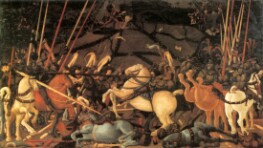
It is a strange painting. I cannot say exactly what I feel when looking at it. Everything is turned into a mess here: the horses, knights, spears and crossbows. On one hand, Ucсello seems to give a glimpse into a perspective of the composition. We can see a dog and rabbits running on the hills giving an impression that they are far away. There are several plans consisting of the battle, the closest hill and what is behind it. On the other hand, the spatial depth is weird since the sizes of remote figures in the background are inconsistent. They seem to be suspended in space without any coherence with the environment. Another contrasting feature of this painting is how Uccello chose to illustrate the battle. It seems to be sluggish and serene. The troops pull each other in this chaos making no severe harm to their bodies. It seems like a theatrical scene with a battle decoration. The colors are also confusing in a sense that the picture is somewhat gloomy and solemn at the same time. I think that this style would be perfect for an illustration of a tale story with kings and princesses. It has its charm as a fantasy representation.

What I like in this painting is clarity and softness. The lightsome characters comprised of Madonna and the Christ child are contrasted with a dark background. At the same time, the colors are soft, revealing the beauty of the lines. The overall softness of the picture is reinforced by the window which opens to the idealistic landscape with a castle and a blue sky.
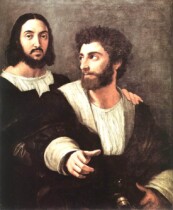
It is an elegant painting with beauty in gesture and eyes of characters. The painting represents two figures on a dark background. Occupying the left side of the painting, the first character places his left hand on the shoulder of his friend looking at the viewer. The second character occupying the central space turns to the first to look at it. He points his finger at the viewer as if he wants to show something. The two characters wear the same clothes; their beards and mustaches are of the same shape. In their eyes, I feel that they have known each other for a long time. Their friendship is profound and their emotions are tender. At the same time, when I look at the painting, I realize that there is an effect of presence in a sense that the characters are very close to me. The first of them is looking at me, the other is pointing his first finger as if I were the object of their observation.

The Virgin and child with Saint Anne by Leonardo de Vinci is a great example of humanism, an intellectual movement of the Renaissance that emphasizes the value and agency of human beings. Humanism prefers critical thinking and reason over acceptance of religious dogma or superstition. That is why many painters of this period including Leonardo de Vinci illustrate the Saints as ordinary persons with their own emotions. In this painting, for instance, we can observe the Virgin sitting on the knees of her mother, Saint Anne. They both are smiling to the child who is pulling maliciously a lamb's ear. Leonardo represents these canonical figures of Christianity like mortal beings expressing tenderness and love. The scene is full of intimate warmth and modesty which was usually not the case for a religieuse painting. We can perceive an implicit intention of the artist to elevate the dignity of the human spirit and to help reveal the capacity of the individual in this progressive world.
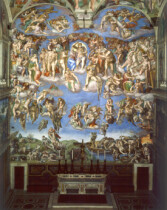
This is just an awesome fresco that impresses by its dimensions and by the quantity of over-muscled bodies of gods. When looking at it, you feel strength and greatness of the figures who are engaged in a divine routine. At the same time, the way they act and interact with each other reminds me the human world with its hierarchy and power struggle. In this visual narrative, Michelangelo created a vigorous fusion between Christian theology and Greek mythology. For instance, Jesus Christ in the center is similar to Hercules, while below we can see a figure on a boat resembling to Charon who carries dead souls to the underworld.
.jpg)
The color of both the sky and the sea seems familiar as if we are watching an old movie with nostalgic charm. It is a mythological fantasy in which Greek gods are depicted just flawlessly. The bodies are intricate and the movements are rhythmic. On the other hand, the painter is not committed to realism. We see an imaginary world with some discord between the figures and the landscape. For instance, a shell on which Venus is standing is out of scale or the trees seem unrealistic. The figures share the same facial features that make them look like members of the same family. All this contribute to the impression that we experience a myth with some degree of reality.