If I did not know the title of the painting, I might think that it depicts daily routines of habitants of the city in the 16th century. Indeed, we can observe different kinds of figures each of them playing his own role. There seem to be all classes of the medieval society on the street: knights, nobles, merchants and peasants. The king Charles VIII is present as well, but he is not standing out much from the crowd. Staying in the background, he is surrounded by other individuals like him with their own intentions and beliefs. That is why it is difficult to extract the main character of the painting. Probably, the main idea of the painter was to depict the triumphal entry of the king as is without exaggeration and any religious impact. Moreover, the diversity of characters with the expression of personal qualities gives this event some routine and desacralization.

Highly decorative, this painting gives me a feeling of luxuriance. If we look closely at it, we can notice tiny details applied in a strict manner. Clothing patterns impress with repetitive detailing and fancy design. Hair of the Saints and angel's wings seem to be a result of the laborious work as well. On top of that, the background is inlaid with gold leaf to enhance the decorative quality. Though the figures of the two inner scenes face each other, their interaction by gaze and gesture is formal without any emotional depth. It could be that the painter intended to show primarily the beauty of the style in its ideal form, and was less preoccupied by the specificity of characters.

This paining is a great representation of the solemnity. The Saints and angels are celebrating the coming of the Christ. Many of the figures are playing musical instruments. We can clearly see the contrast between the white Christ's clothing and that of the rest of characters. Holding a flag, the Christ is distinctive by his height and greeting posture. The overall atmosphere is joyful since the painting is composed of different colorful lightful shades. However, the seriousness of the event is transmitted by the golden tint which Fra Angelico used for this background with generosity.

Many painters of the Rennaissance period were obsessed by the arts of Greece and Rome as medieval art did not show signs of cultural progress anymore. They wanted not to copy but to refine art, invent something new based on the classical principles. That is why many of the subjects in paintings of that time refer to mythology and classical antiquity. Raphael decorated one of the rooms in the Apostolic Palace in Vatican by a marvelous fresco called The school of Athens. It depicts the Academy founded by philosopher Plato in 387 BC in Athens persisting until 529 AD when it was finally closed by Justinian I. The Academy was the major center of philosophy in the classical civilisation. Being Raphael's masterpiece, the fresco is a very sophisticated synthesis of philosophy and theology. In the center, we can observe Platon and Aristotle as the central figures of the scene. The two sculptures in the backround refer to Apollo, god of light and music, and Minverva, god of wisdom. Raphael was inspired by archictural works of Donato Bramante, an Italian architect, who propably helped the painter with interior design and perspective. It is suggested that the building, depicted in the painting, was intended to be an advance view of St. Peter's Basilica, the most renowned work of Renaissance architecture. The church is believed to be constructed on that basis of mathematical calculations in order to create unity and symmetry of the work. In that sense, the Raphael's fresco follows the classical conviction that the nature is governed by rational rules which we can understand and apply to our own creations.

What draws attention straight away in this painting is the face of the man in armor, probably a knight. His expression is real and humane producing an effect of compassion. Francesco is looking at us with his vivid eyes and under bright light we can see that this look is sincere. There is a great contrast between Francesco's palish face and his formidable shining armor which is depicted as a still life object. It looks like the painter wants us to see the interior side of the power, that is a human with his weaknesses and fragility.
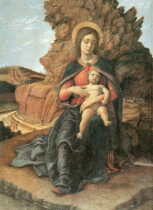
I feel some kind of easiness in what I see as if the characters do not care what is going on around. Madonna by its face expression looks like an ordinary woman keeping a child in her hands. The child in his congealed posture gives an impression of being in an ecstatic state. At the first glance, the background with perspective seems to be too isolated from the front side of the painting, like a decoration of the theatre scene. Nevertheless, shepherds and artisans at work add to the peaceful expression of principal characters. The rock with the cave behind Madonna is gorgeous by its unusual form, which makes Madonna more special. The idea of the artwork could consist in that holy tranquility of the life assured by the habitual order.
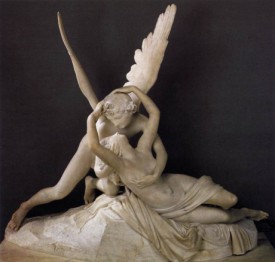
Only the subtlety of a sculptor like Canova could bring to life an image so far removed from everyday reality. An allegory of Eros (Love) and Psyche (Soul) tells the story of a forbidden love between a god and a human, symbolizing the fusion of celestial love and the human soul in one unique dimension. This is how the Canova perceives it. But the desire remains unfulfilled: the intertwined arms of the two lovers embrace, but do not squeeze, the fingers brush against the hair and skin, but do not touch them, and the kiss remains suspended. The languid abandonment of the woman's body in the arms of her lover signifies a surge of the soul which, however, remains anchored to the earth. The sinuous and soft curves of the entwined bodies create a fluid and harmonious movement. The arms attaching like rings with delicate grace allow the figures, located on distinct but converging planes, to come together.